
The neobroker market is fiercely competitive. Competition in global retail brokerage has shifted. Low trading fees were once a powerful USP, but they have now become a prerequisite for retail investors. Pure marketing is an important approach for building traction, but how do you really win users? How do you stand out? How do you win in the market?

Terms and conditions remain a relevant factor. Low trading fees, free savings plans, and transparent cost structures are still a reason why customers choose a provider, and no company can afford to neglect them. The crucial point, however, is different: price alone no longer drives differentiation. Market-wide, terms are so similar that they are increasingly becoming a basic requirement rather than a unique selling proposition. Furthermore, a price advantage can be matched within a short period of time.
The relevant question is therefore no longer how a provider can become cheaper, but where they are present in the customer's decision-making process.

An investment decision is rarely just a single click. It is preceded by a research process that often takes significantly more time than the execution itself.
The customer wants to understand what they are investing in. They look for key figures, valuation levels, comparisons with similar assets, upcoming events, historical performance, analyst expectations, and context. They gather information before committing capital.
If they find this context within the application, the entire process stays within the product. If they don't, they move their research elsewhere—to financial portals, comparison sites, or other sources.
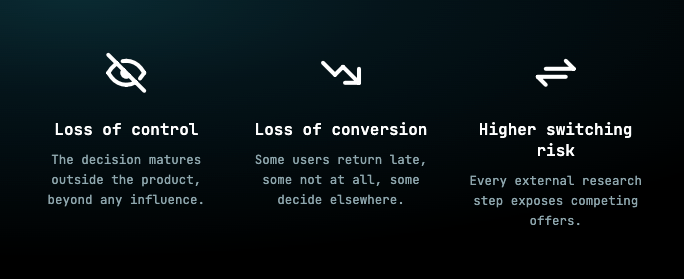
If the customer leaves the application to find information, several disadvantages arise for the provider:
Executing a trade is therefore only one part of the value creation process. Customer loyalty is built where the decision is made. A provider that only handles execution owns the less valuable part of the process.
A robust data and analysis layer is therefore less a matter of equipment and more a matter of positioning. It impacts several key performance indicators simultaneously:
Unlike a price advantage, which can be neutralized in the short term, a superior data layer cannot be replicated in a few weeks. That is where its strategic value lies.

The next step in this evolution is already emerging. Neobrokers and neobanks are increasingly integrating AI assistants that answer questions in natural language. Instead of looking up metrics to interpret them personally, users can now have them explained, compared, and contextualized directly. What a company earns, how it is valued, what the latest figures mean, or how two stocks compare. The research process, which previously required multiple external sources, can now potentially take place in a single dialogue within the application.
For customer retention, this is the logical culmination of the previous argument. An assistant that handles the entire research process keeps not just a part, but the complete decision-making journey within the product.
Crucially, however, such an assistant is only as good as the data it accesses. A language model without a sound, structured, and up-to-date data foundation generates plausible-sounding but unreliable statements and in a financial context, unreliability is an intolerable error. The assistant requires a machine-readable foundation of fundamental data, estimates, corporate actions, and price data that it can query reliably. The competitive advantage thus shifts back to the underlying data layer. It is not the model that determines quality, but what it accesses.
The fact that this layer is still missing in many products is rarely due to a lack of development capacity. Almost every product team in this market could develop a data-driven, powerful brokerage application with AI capabilities. The bottleneck lies one level deeper: in the procurement of the data.
Traditional data acquisition models are designed for a different use case: the analyst at a terminal, not an application with a large number of concurrent end users. In practice, this repeatedly leads to the same problems:
For institutional users with fifty analysts, this model is appropriate. For a product team looking to roll out a feature to a large retail user base on short notice, it doesn't work. The business case fails at the procurement stage before a single line of code is written. As a result, coverage gaps that could have been technically closed long ago remain.
A data layer that supports today's competition should meet six criteria:
Bavest is designed for these requirements. The platform processes financial data in an AI-native way from sources that were not originally machine-readable, delivers it via an API in a consistent schema, and covers areas that traditional providers treat as edge cases—all without the upfront licensing overhead of conventional procurement models. Because the data is consistently structured and machine-readable, it serves as an immediate, reliable foundation for AI assistants and can be integrated directly into existing applications.
Favorable terms remain a necessary component of a competitive offering. However, they no longer suffice as a sole differentiator, as they have become standardized across the market and can be easily replicated in the short term.
The next competitive advantage lies in the entire decision-making process. A provider that directs customers to external sources for research forfeits the most value-intensive part of the trade. A provider that integrates this process within their application gains in dwell time, conversion, frequency, and monetization potential.
The difference between these two approaches is fundamentally not a matter of development capacity, but of data access.
Book a demo now to learn more about our solutions.
blog

